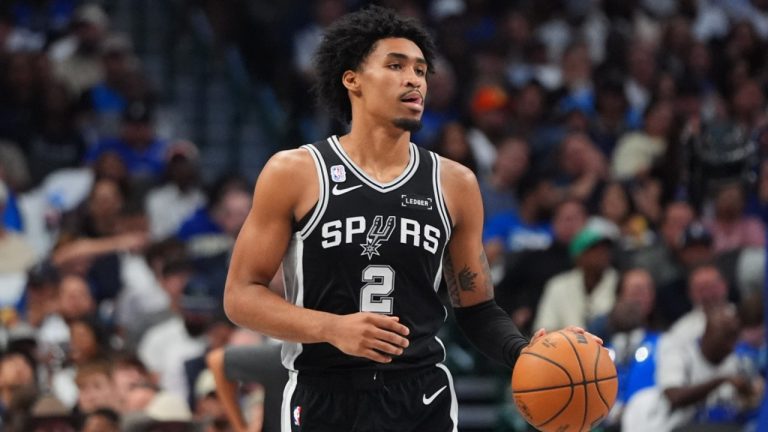
Dylan Harper has publicly said he wants to start for the San Antonio Spurs in the 2026-27 campaign. In a GQ Sports interview released on September 28, 2026, he told Stephon Castle he had no plans to come off the bench.
“What’s the political answer here?” Dylan Harper says, looking down at my recorder again. He calibrates his voice into its cheeriest pitch: “I’m going to do whatever the team needs me to do, man. If that’s come off the bench….”
He stops. “That’s crazy. Fuck no. I ain’t coming off no bench.”
Although Dylan Harper says he was joking, the Spurs should use the quote to their advantage. If they start him, it will likely spotlight his biggest weakness: shooting.Head coach Mitch Johnson implemented an offensive system last season centered on transition play.
Spurs Offense
The Spurs were in transition on 21.3% of their offensive plays, averaging 24.1 per game, the 5th most in the league. 51.4 percent of the team’s transition possessions went to three players: De’Aaron Fox, Victor Wembanyama, and Stephon Castle. Each one of those players averages at least four possessions per game.
In transition, a player usually pushes the ball up court until he reaches the three-point line. Then he analyzes the defense’s current state.
If the defense has multiple players inside the arc, the ball handler will pass to a teammate behind the arc to attempt a three-pointer. If the defense is guarding the three-point line, the ball handler will drive to the basket and attempt a shot closer to the rim.
On March 8, 2026, the San Antonio Spurs faced the Houston Rockets. De’Aaron Fox delivered an inbound pass to Stephon Castle with 9:22 left in the first quarter. Castle took two dribbles before passing the ball back to Fox.
De’Aaron Fox pushed the ball down the floor until he reached the three-point line. He saw three Houston defenders inside, so he passed the ball to Victor Wembanyama. Victor Wembanyama missed an open three to end the transition possession.
Dylan Harper’s role
If the Spurs run the same type of offense in 2026, it would put Dylan Harper in a position where he is forced to use his biggest weakness. He would routinely stand behind the arc as a floor spacer.
During his lone college season, Dylan Harper shot 33% on five attempts per game. He showed a slight improvement as a rookie in the NBA, shooting 34.3% on 2.6 attempts per game.
Consequently, making him a starter increases the likelihood that he will struggle offensively. If Dylan Harper struggles, the Spurs can use the media to create the narrative that he is best suited for the bench. Eventually, San Antonio would gain fan support as Dylan Harper continued to struggle. These factors will make it acceptable to move him to a bench role.
An expected counterpoint is that Dylan Harper has a solid track record of making catch-and-shoot threes. In college, he shot 36.8% on two attempts per game. However, 65% of those threes were wide open, and he shot 51% on wide-open threes.
He had similar success in the NBA. He made 38.7% of his catch-and-shoot three-pointers on 2.1 attempts per game. 95.2 percent of those threes came with 6 ft of separation from his defender, and he made 33.1% of those attempts.
Despite those numbers, I would start Dylan Harper because it’s the best shot for him to struggle early in the season. That lets the Spurs shape the narrative that Dylan Harper is better suited to the bench at this point in his career.
Leave a Reply