
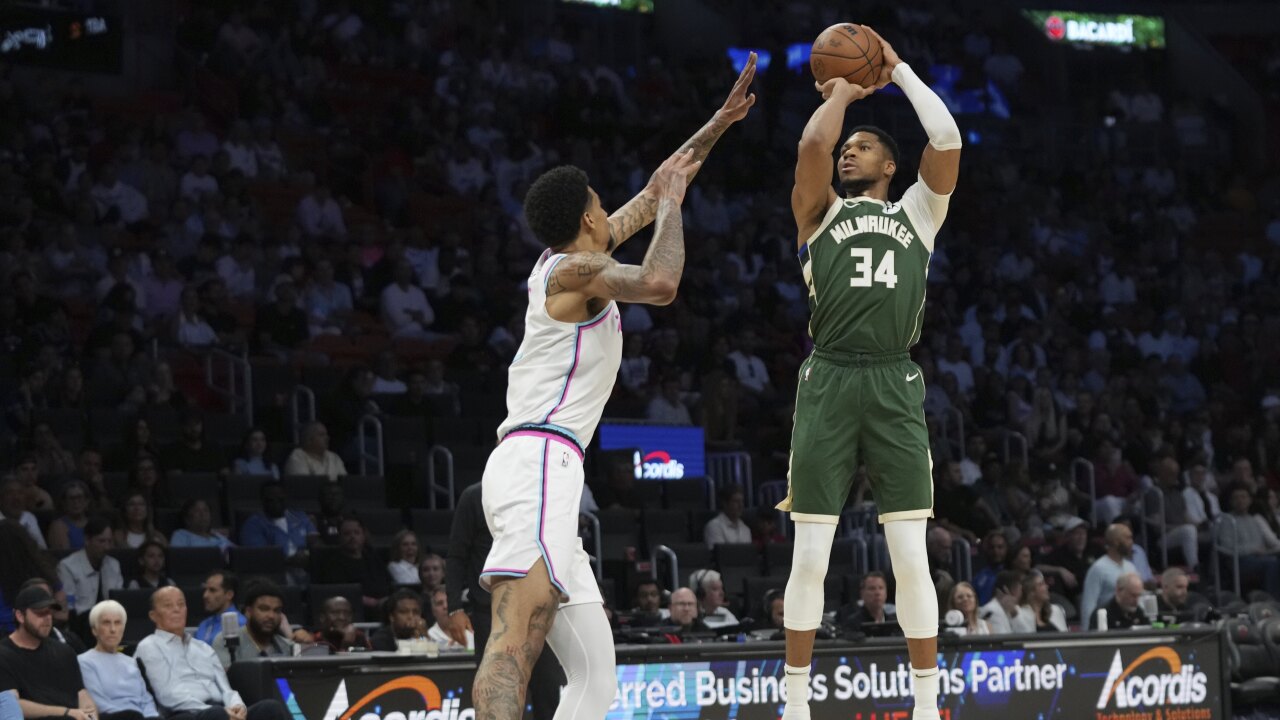
Miami Heat Trade Speculation Around Kel’el Ware
There is a perception within the media that second-year center Kel’el Ware will be included in the Miami Heat’s trade offer for Giannis Antetokounmpo. On January 30, 2026, Tim Bontemps and Brian Windhorst listed him as one of the tradeable assets Miami will allow Milwaukee to choose from in a potential trade.
“The Heat have just two tradable first-round picks, Herro (a Milwaukee native), Kel’el Ware and Jaime Jaquez Jr., but not the premium trade package it could require to land Antetokounmpo. Don’t expect the front office to do much before the deadline. It will either turn its attention to the offseason if Antetokounmpo remains a Buck or prepare for summer 2027, when Miami could have substantial cap space”.
Although I understand Miami’s desire to acquire Giannis Antetokounmpo, given his superstar status, Kel’el Ware is a better fit for the current version of the team. If Miami were to acquire Antetokounmpo for the package stated above, they would only have one player with an above-average three-point percentage in the rotation.
Starting shooting guard Norman Powell has a career three-point percentage of 39.8% on 4.5 attempts per game. He entered the league prior to the 2015-16 season; since that time, the league average three-point percentage has been 35.9%.
Giannis Antetokounmpo’s Play Style and Miami’s Shooting Concerns
The lack of shooting on the Miami Heat roster will make it harder for the team to succeed offensively. This issue becomes even more pronounced considering Giannis Antetokounmpo’s play style.
He prefers to spend roughly 40% of his offensive possessions between transition and post-up situations. In fact, over the past five-plus seasons, Giannis has spent 25.5% of his offensive possessions in transition, averaging 6.8 per game.
Giannis Antetokounmpo spends 14% of his possessions posting up, averaging 3.7 per game. When Giannis is participating in either play type, multiple teammates space the floor by positioning behind the three-point line. This allows Antetokounmpo to have an open paint with more room to operate.
On November 3rd 2025, Ryan Rollins dribbled the ball up to the court with 4:19 left in the fourth quarter against the Indiana Pacers. After he passed half court, Ryan gave the ball to AJ Green, who was standing on the left wing.
A J held the ball for a few seconds until Giannis approached and received the pass. Antetokounmpo took a few steps toward the left sideline, then turned his back to the basket to post up. As he prepared to back down Pascal Siakam, Isaiah Jackson came over to help.
The impending double team led Giannis Antetokounmpo to pass to Green, who ended the possession by missing a deep three-pointer. As the possession was unfolding, Gary Trent and Myles Turner were on the other side of the court, standing behind the three-point line as floor spaces.
This situation could create problems for him with the Miami Heat. The roster’s lack of shooting means opponents will leave players open behind the arc, hoping the ball handler will be forced to pass to the perimeter for a low-percentage shot.
Offensive Trade-Offs and Why Kel’el Ware Fits Better
Consequently, Miami will be in a position to decide between the lesser of two evils.
- Play into the defense and pass the ball to the perimeter for a low percentage three.
- Have the ball handler shoot against multiple defenders for a highly contested shot.
Choosing option one limits Antetokounmpo’s scoring. Over the past five seasons, he has been effective only in the restricted area, shooting 77.2% on 10.5 attempts per game.
When Giannis Antetokounmpo is outside the restricted area, his field goal percentage drops to 34.9% on 8.3 attempts per game. As a result, Miami must take more contested shots to maximize its offensive impact.
Antetokounmpo regularly takes contested shots, averaging 9.3 per game under tight coverage over the past five seasons. According to nba.com, a tight coverage shot is when a defender is 2-4 ft from the shooter. He has made 66.5% of these attempts. Despite this contested success, stopping the Miami Heat is easier.
Miami should keep Kel’el Ware rather than trade for another player until they can add more above-average shooting. Ware has demonstrated strong three-point ability, shooting 37.2% on 2.2 attempts per game over 109 career games.
The ability to space the floor gives the ball handler an outlet when they’re being surrounded by multiple defenders. Kel’el Ware’s ability to be an outlet is vital to Miami’s offensive system this season.
Miami has installed an offensive system built on playing fast until reaching the top of the key. Then, Miami identifies the weakest defender and passes the ball to the player that the defender guards.
Heat vs Mavs
On November 24th, 2025, Davion Mitchell received an inbound pass from Jaime with 4:34 left in the fourth quarter. Mitchell dribbled the ball to the top of the key in 3 seconds. The team noticed that the weakest defender on the Dallas Mavericks, Ryan Nembhard, was guarding Tyler Herro.
Mitchell passed to Jaquez Jr., who passed to Tyler. Herro isolated Ryan, got past him in two seconds, then took a couple of steps toward the basket and made a floater.
As the play unfolded, Jaime, Mitchell, and Pelle Larrson were spaced out behind the arc as outlets if Tyler was double-teamed.
Miami’s offensive system has driven its rise to the top of the rankings in pace and isolation possessions, top 5th the league in both. Over their first 49 games, Miami is averaging 104.9 offensive possessions per game lead the league. They are also averaging 11.4 isolation possessions per game, 4th in the league.
Addressing the Defensive Side of the Argument
One of the rebuttals to this argument from readers is that I am only talking about the offensive side of the floor. So far, that is true, but let’s talk about defense. At first glance, Giannis Antetokounmpo appears to be a good defender based on his individual defensive statistics.
Over the past five-plus seasons, Giannis Antetokounmpo has held opposing players to 44.5% shooting on 12 attempts per game, 3.5% better than league average.
However, these statistics give a false impression. In reality, Giannis Antetokounmpo often gives minimal defensive effort.
Film Evidence vs. Defensive Metrics
On May 11, 2022, Giannis Antetokounmpo had Grant Williams as a defensive assignment with 1:35 left in the fourth quarter. The Boston Celtics place Williams in the right corner, operating as a floor spacer.
On the other hand, Giannis Antetokounmpo placed himself between the three-point line and the paint. He did not move for most of the play until Jayson Tatum shot the ball to get the rebound.
This is not an isolated incident; he exhibited similar behavior in 2025. On November 3 2025, Giannis Antetokounmpo was assigned to defend Pascal Siakam with 2:18 left in the fourth quarter. Pascal Siakam was standing at the top of the key when he received a pass from Jarace Walker.
Upon receiving the pass, Aaron, who was guarding Antetokounmpo, came over to set a screen on Siakam, Antetokounmpo’s defender.
Siakam, assigned to defend Antetokounmpo, went over the screen, but Antetokounmpo stayed in place, watching the rest of the play as Siakam was left with a wide-open three-pointer.
Defensive Assignments and Context
The difference between his defensive statistics and his film lies in his defensive assignments. Specifically, during the 2021-22 season, Antetokounmpo’s most frequent defensive assignments were: Anthony Davis, Jakob Poeltl, Clint Capela, Grant Williams, and Mo Bamba.
Over the course of two games, he guarded each of these players for more than 27 partial possessions. Besides Anthony Davis, these players are not considered to be offensive threats.
Once again, this is not an isolated incident. In the 2023-24 season, Antetokounmpo guarded Julius Randle, Patrick Williams, Jabari Smith Jr, Kyle Kuzma, and Rui Hachimura in more than 30 partial possessions each over two games.
As a result, his defensive statistics benefit from guarding players who mostly operate off the ball.
Comparing Giannis Antetokounmpo and Kel’el Ware on Defense
Consequently, Giannis Antetokounmpo is not a significant defensive upgrade over Ware, who can only defend in small, confined spaces near the basket. If Kel’el Ware tries to go out and defend on the perimeter, he will have problems.
This is because Kel’el Ware has a habit of constantly trying to go after the ball to create a turnover. Unfortunately, he is always doing big athletic movements to go after the ball and create turnovers. Consequently, when he misses the ball, he is out of position for a significant portion of the rest of the play.
Late-Game Example Involving Kel’el Ware
On November 17th, 2025, Kel’el Ware was assigned to defend Karl-Anthony Towns with 2:32 left in the fourth quarter. The New York Knicks placed Karl-Anthony Towns at the top of the key for the beginning of the play. On the other hand, Kel’el Ware was standing on the free throw line.
A few seconds later, Karl-Anthony Towns received a pass from Josh Hart and immediately decided to shoot a three. However, Ware realized this and made a large leap to try to block the ball and create a turnover. The large leap made Karl-Anthony Towns double clutch before shooting the three, and it took Kel’el Ware completely out of play.
Ultimately, I would rather have the overeager/highlight-based defender in Ware than Antetokounmpo, who gives minimal effort. Given Miami’s current situation, Kel’el Ware is a better fit than Giannis Antetokounmpo.


Leave a ReplyCancel reply