
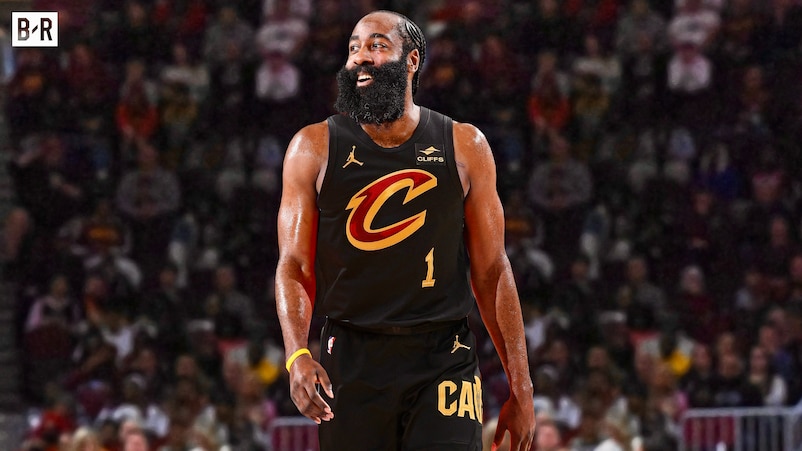
The Cavaliers’ Plan for James Harden
The Cavaliers reportedly want to use newly acquired guard James Harding as a playmaker. Joe Vardon and Jason Lloyd of The Athletic stated on February 4, 2026, that Donovan Mitchell asked the Cavaliers front office to acquire a pass-first point guard prior to the trade.
“Two league sources also said Mitchell specifically wanted Harden, who is 6-foot-5, durable and comfortable as a pass-first point guard.”
Mitchell’s request for a pass-first point guard is a bad omen for Harden’s tenure with the Cavaliers. When James was asked to be a pass-first point guard, his statistics declined significantly.
The Brooklyn Turning Point
Eleven games into his Brooklyn Nets tenure, Harden was pushed to become a past first point guard by one of his teammates. On February 14, 2021, Kyrie Irving told the media that he had a conversation with James Harden four days earlier. During that conversation, he told Harden to play point guard.
“I just looked at him, and I said, ‘You’re the point guard, and I’m going to play shooting guard.’ That was as simple as that.”
The conversation caused a significant shift in how James Harden played the game . Prior to arriving in Brooklyn, James Harden was a ball-dominant guard who primarily looked to score.
James Harden’s Houston Profile
Over his final three seasons with the Houston Rockets, James Harden averaged 85.1 touches per game, ranking in the top 10 in the NBA, and held the ball for 6.3 seconds per touch, ranking in the top three.
He would use these touches to focus on isolating his defender . James Harden spent 42.9% of his offensive possessions in isolation play, averaging 13.5 per game. He was very productive in the play type, averaging 15.4 points per game, shooting 41.7% on 10.8 field goal attempts.
The play type also helped elevate his free-throw attempts .
James Harden went to the free-throw line on 17.1% of his isolation possessions, averaging 1.9 free throws per game in that play type. He led the league during this period in total free-throw attempts with 10.9 per game.
What Changed in Brooklyn
Both of these factors made him the top scorer in isolation play. However, his possessions were cut by 42.2% in Brooklyn, partly due to the conversation with Irving. During his Nets tenure, he spent 32.7% of his offensive possessions in isolation, averaging 7.8 per game.
The decreased opportunities in the play type were the catalyst behind free throw and scoring opportunities declining. James Harden went to the free-throw line 17.8% of the time in isolation plays, averaging 1.4 per game. The decline in free-throw attempts hurt his overall effectiveness, as he averaged 8.4 points per game, shooting 40.6% from the field on 6 attempts.
Harden made up for the decline in isolation opportunities by passing more often. During his Brooklyn tenure, he averaged 65.3 passes per game, a 30.3% increase from the final three seasons in Houston. These additional passes generated 10.5 assists and created 25.9 points per game for the team, an overall increase in playmaking production of 31.5%.
In Houston, he averaged 50.1 passes and 7.9 assists per game, helping the team score 19.7 points per game.
Scoring Decline and Media Narrative
The role change led to a 30.6% drop in scoring. In Houston, he averaged 33.7 points on 44.5% shooting from 22.3 attempts per game; in Brooklyn, he averaged 23.4 points on 44% shooting from 16.3 attempts.
As a result, the media began creating a narrative that James Harden was on the decline. On October 28, 2021, Dan Devine, formerly of The Ringer, wrote an article alluding to a perceived decline.
“Those things seem like they’re about a lack of burst: an inability to blow past defenders off the dribble, create space in tight windows, or elevate above the defense to finish. (They’re also due to defenses, emboldened by the removal of Irving from a roster with few threats to knock down 3s besides Patty Mills and Joe Harris, making a more concerted effort to pack the paint.) We’ve seen it for the past decade: When Harden’s right, he’s able to use his elite combination of strength, quickness, and balance to consistently generate clean looks and knock them down, inside and out.”
Philadelphia Repeats the Pattern
Brooklyn wasn’t the only team that asked him to play the past first point guard role. Former Philadelphia head coach Doc Rivers wanted him to play the same role on the team.
On June 13, 2023, Doc Rivers told Bill Simmons that he wished James Harden passed the ball more during his Philadelphia tenure.
“It was challenging, more because we were fighting two things—and not like visually fighting—it was James is so good at playing one way, and the way I believe you have to play to win, in some ways, is different,” Rivers said (1:01:13 mark). “Because it’s a lot of giving up the ball, moving the ball, coming back to the ball. I would have loved to have him younger, when that was easier for him because giving up the ball and getting back the ball is hard. It’s physical, it’s exhausting.”
Doc Rivers made this statement despite James’s similar facilitator role in Brooklyn. He averaged 67.3 passes and generated 10.6 points per game, resulting in 27.9 team points. His isolation possessions fell to 6.8 per game; Harden scored 7.3 points on 39.1% shooting from 4.9 attempts. Ultimately, he averaged 21 points on 43.1% shooting from 14.3 attempts per game.
Harden’s comeback in Los Angeles
Harden left Philadelphia after the 2022-23 season, when the organization declined to offer him a contract extension, and was traded to the Los Angeles Clippers early in the 2023-24 season.
During his tenure in Los Angeles, James Harden experienced a scoring resurgence, driven by an increase in isolation plays. Over his final 120 games in Los Angeles, he ran isolation on 39.1% of his offensive possessions, averaging 9.3 isolation plays per game. In these situations, he averaged 9.9 points per game while shooting 38.7% on 6.8 field goal attempts per game.
James went to the free throw line on 21.3% of his possessions, averaging 1.8 free throw attempts per game. His production in isolation situations helped him average 24.1 points per game, while shooting 42% on 17.4 field goal attempts each game.
On the flip side, the distribution statistics looked similar to those during his Houston tenure. He averaged 51.8 passes per game, generating 8.4 assists and creating 21.1 points for the team.
Given the evidence above, James Harden needs isolation to maximize his offense.
Why Cleveland Is a Familiar Setup
Unfortunately, Harden’s new era with the Cavaliers will be similar to his tenure in both Brooklyn and Philadelphia. As I mentioned earlier in the article, early reports from Cleveland indicate the team will use him in a pass-first role.
James will frequently be passing out of the pick-and-roll , as it is one of the Cavaliers’ favorite offensive sets. The Cavaliers have implemented a pick-and-roll offense since the 2024-25 season. They run the play type on 19.4% of their possessions, averaging 22.1 per game.
When they run the play type, the Cavaliers usually have two or three players standing behind the arc. This is because the team wants the paint to be open, giving the ball handler and screener maximum room to operate.
The Play That Explains Everything
On January 16, 2026, Donovan Mitchell dribbled the ball up the court with 5:22 left in the fourth quarter against Philadelphia. Upon arriving at the top of the key, he wanted to go over a screen that Allen was setting for him.
Unfortunately, he couldn’t get separation from his defender, leading him to turn around and begin a drive to the basket. After a few steps, Mitchell performed a pocket pass to Allen. Once Allen received the ball, he went to pass the ball to De’Andre Hunter, who was standing in the right corner.
Tyrese Maxey intercepted the pass, resulting in a turnover. Meanwhile, Jaylon Tyson and Hunter remained behind the three-point line throughout the play.
What This Means for Harden in Cleveland
Harden will likely take on Mitchell’s role during his tenure with the Cavaliers. If so, his statistics should resemble those from Brooklyn and Philadelphia more than Houston. As a result, the familiar narrative that he is the trainer may emerge again, though it would not be his fault.



Leave a ReplyCancel reply